
CEOS: Data Center and Edge Computing in Space
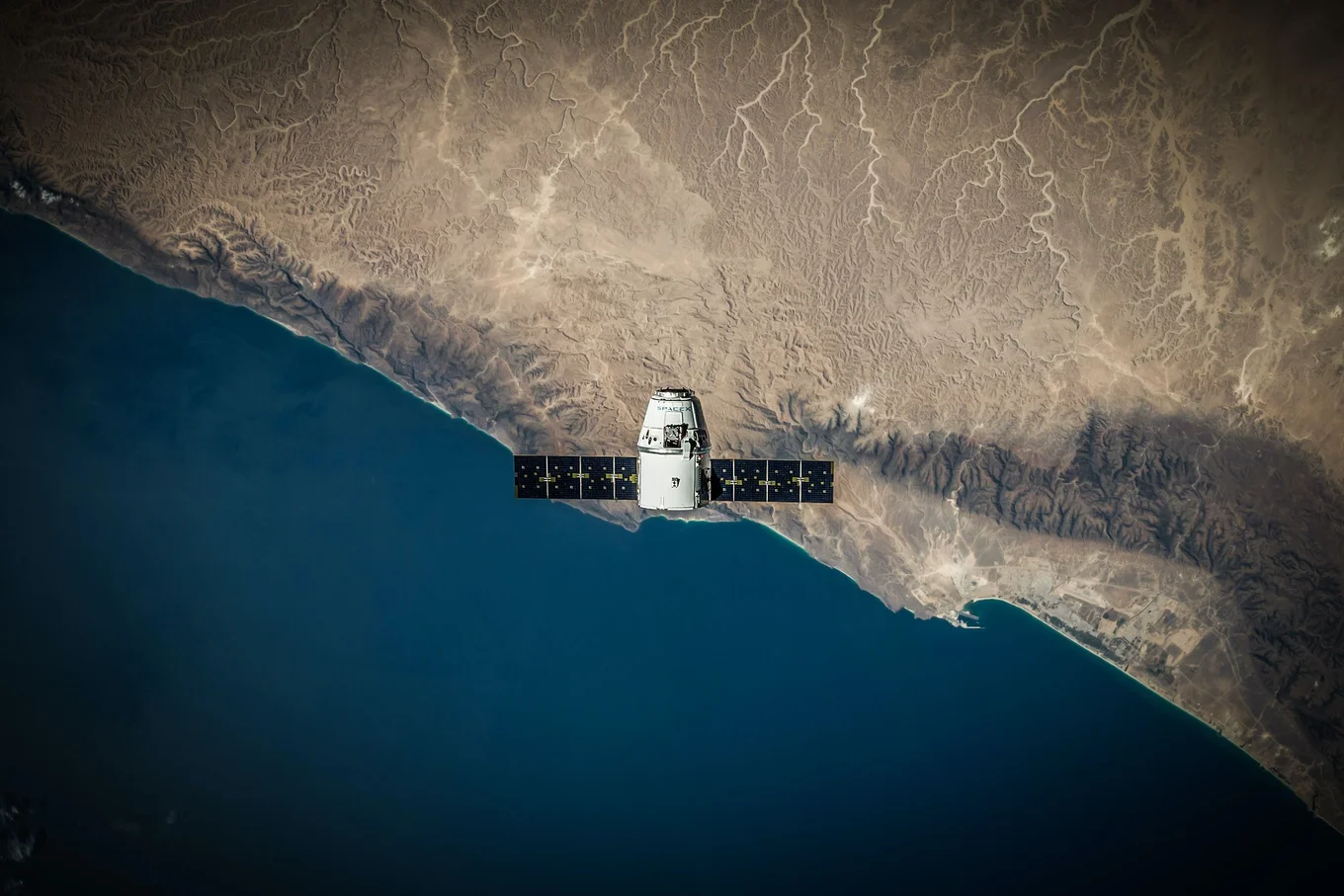
Putting the processing on the satellite instead of the ground, so an Earth observation mission can spot a wildfire and raise the alarm from orbit.
- Funder
- Bpifrance
- Programme
- France 2030
- Partners
- STEEL Electronique, ELSYS Design, IP-Maker, Thales Alenia Space
The challenge
An Earth observation satellite is a good way to watch the planet. Compare two images of the same place and the differences tell you about deforestation, biodiversity loss, a chemical spill or a fire.
The catch is where that comparison happens. Normally the images come down to the ground first, which costs time at exactly the moment time matters, and saturates the downlink with data that is mostly uninteresting. Only the changes are worth having. Processing on board would solve that, but a conventional satellite CPU is too slow to do it, and a satellite is usually built to fly one mission with one payload for its entire life.
So a satellite spends much of its orbit idle, sending down pictures of places where nothing happened, while the alert someone actually needs waits on a ground station pass.
The approach
CEOS, for data Center and Edge cOmputing in Space, began on 24 March 2025. It is a collaboration between STEEL Electronique, ELSYS Design, IP-Maker, Thales Alenia Space and Tarides, funded by Bpifrance. The aim is a satellite that carries several applications at once and switches between them, so it can detect wildfires over land and illegal fishing over ocean on the same orbit.
The hardware. STEEL designs and manufactures the demonstrator board, built on a Xilinx Versal SoC with high-performance NVMe storage using IP from IP-Maker, so sensor data can be captured quickly and processed afterwards.
The change detection. ELSYS, who are the experts here, design the change-detection applications the demonstrator carries. Detection runs from simple binary detection, through 'from-to' detection of one specified change, to multi-class detection that classifies several kinds of change at once, across both optical and radar imagery. Deep learning then validates what the algorithms find, so a shift in tree cover caused by a different sun angle or time of day does not go out as a deforestation alert.
The software. This is Tarides' part. Working with the partners behind ORCHIDE, Thales Alenia Space in particular, we are building a minimal Linux-based OS and the lightweight orchestration components that run on every board. Applications are deployed as isolated unikernels, the approach taken by SpaceOS.
A unikernel is built for one application, so it carries only what that application needs. That makes it small, cheap to start and stop, and independent enough of the host that a simple hypervisor is sufficient to supervise it, which is what makes swapping payloads in flight practical. It also inherits the memory safety guarantees of OCaml, which matter rather a lot on a spacecraft you cannot reach.
The hard part is hardware acceleration. The FPGAs and GPUs that make on-board AI fast have to be reachable from inside a unikernel, through the virtualisation barrier that gives the unikernel its isolation in the first place, and as far as possible without binding the software to one accelerator.
Where the project is now
CEOS is still running. We wrote it up at kick-off in this earlier post on the CEOS project, and more about SpaceOS is on the website of our sister company Parsimoni, which builds it.